

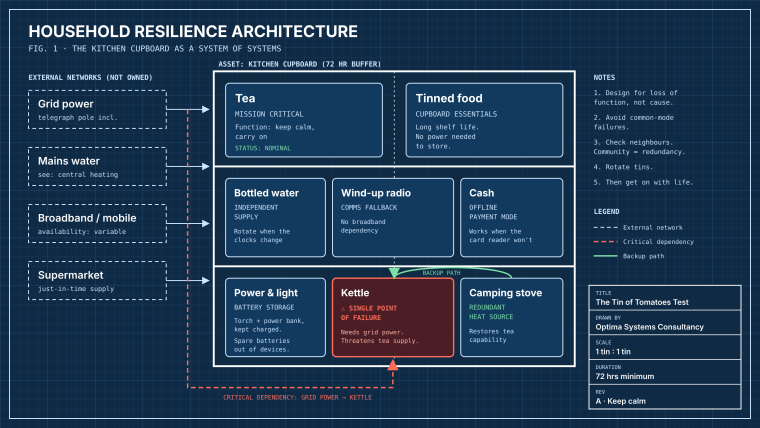
Advice to keep three days of emergency supplies at home is everywhere right now, from government campaigns to social media feeds. What often gets lost is the context. The reality behind it is refreshingly ordinary. A central heating leak means turning off the water and topping up the cat’s bowl from bottled water. A single failed telegraph pole leaves one house without power for three days. After the Great Storm of 1987, some villages waited days for fallen trees to be cleared before traffic could get through.
None of these is a doomsday scenario. All of them are system failures. The useful question is how to keep the essentials working until normal service returns. That makes deciding how many tins of tomatoes to keep in the cupboard a surprisingly practical systems engineering problem.
Not every household can afford to stock up, and nobody should feel judged for that. Cost is a real constraint, not a failure to prepare. Where a modest buffer is within reach, it is a sensible aim but not a measure of how responsible a household is.
Your home is a system of systems
A household relies on water, power, heat, communications, food and transport, each delivered by networks you neither own nor control. Systems engineers spend their working lives asking what happens when one of those interfaces fails. The answer is rarely dramatic. It starts as inconvenient, becomes expensive, and turns risky if it goes on long enough.
A more useful question than “what could go wrong?” is “how long can we keep functioning when something does?” Engineers call this graceful degradation: keeping essential functions running at a reduced level while the fault is fixed.
Impact matters more than cause
UK Defence Tech’s overview of grey zone threats facing the UK highlights a familiar systems engineering principle: intent does not determine impact. A cyber-attack, storm, software fault or submarine loitering near a subsea cable can have the same consequences at home: no power, no internet and no deliveries.
Last week’s Microsoft 365 outage was a timely example. Microsoft attributed it to a technical fault, yet it disrupted services from NHS email to police reporting, with the public asked to report crimes by phone. The article’s wider warning is about concentration risk. When many services share one backbone, a single failure travels a long way.
Resilient design therefore focuses on essential functions and how they can fail. You cannot anticipate every threat, but you can prepare for 72 hours without water, power or communications.
Sizing the buffer
Three days is a buffer for the far more common local failure: the leaking pipe, the failed pole, the blocked road. It is not a promise that every emergency will be over in that time. Several European countries and Canada recommend households hold between three and ten days of supplies. Major disasters are a different scale of problem: with Hurricane Katrina the textbook case, it can take around two weeks for governments and aid organisations to get fully into gear.
Why so long? Because government is itself a system made of people. Call it the snowplough dilemma: the person who drives the snowplough still has to get to work. During the fuel protests, one lesson was that teachers needed to be treated as key workers. If teachers cannot work, children stay at home, so their parents stay at home, and both the economy and government grind to a halt. Every responder is also a household facing the same disruption as everyone else.
In engineering terms, it is a buffer sized to the realistic recovery time for the most likely failures, with some headroom. It buys time and, more importantly, options. Nobody should have to head out into a storm for a packet of pasta.
That buffer does not have to be bought in one go. Good design works within its constraints, budget included, and a few extra items in each weekly shop builds it gradually. Resilience is also a community property. Knowing which neighbours might need a hand, and who could lend one, adds a layer of redundancy no cupboard can match.
Watch for common-mode failures
A common-mode failure is when your backup fails for the same reason as your primary. Household versions are easy to spot once you look: a cordless phone that needs mains power, a smart thermostat that needs Wi-Fi, a freezer full of food and no way to cook it without electricity, or a wallet with only contactless cards when the payment network is down.
A few quick checks:
- Information: can you get news if mobile and broadband both fail? A battery or wind-up radio covers it.
- Heat and cooking: can you boil water without mains power?
- Money: do you have some cash at home?
- Water: is drinking water stored independently of the supply that might fail?
- Power: are torches and power banks charged, with spare batteries stored outside the devices?
For the full checklist, see the UK Government’s Be Ready guidance, which recommends households prepare three days of supplies
Then get on with life
The final piece of advice is the least technical: prepare for the essentials, not every imaginable scenario. Whatever happens may still be weird and unpredictable, but dwelling on doomsday detail does nobody’s wellbeing any good. Once your supplies are in, get on with your normal life.
That is sound systems thinking too. Resilience is designed in, checked periodically, and then left to do its job. Rotate the tins. Check the batteries when the clocks change. Keep the kettle option open.
A spare tin of tomatoes is equally effective against zombies, sentient robots or, ironically, killer tomatoes. And a personal supply of tea remains near-universally recommended for keeping calm and carrying on across the known multiverse.